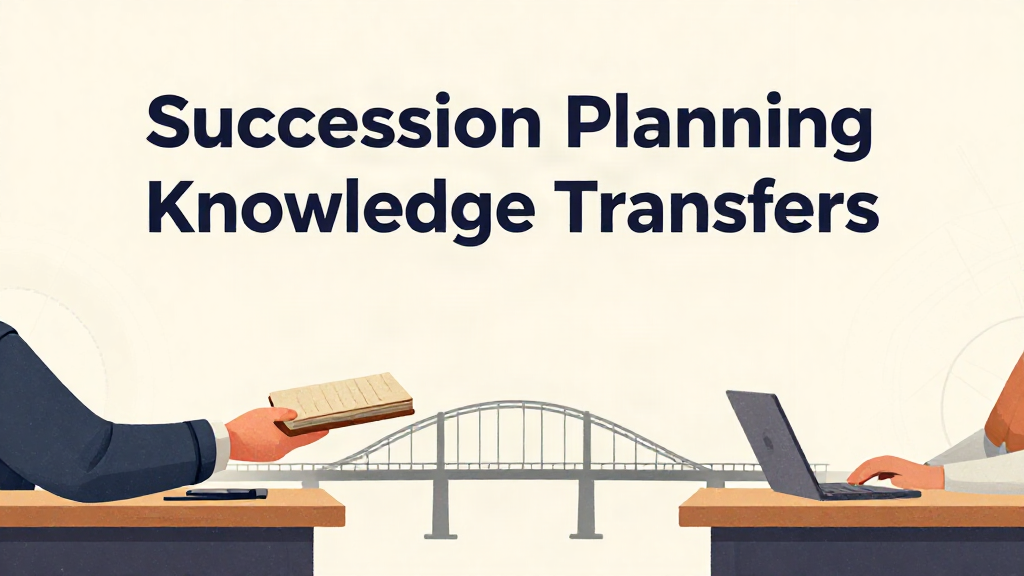
Knowledge transfer interview questions: a working guide
What an exit interview misses, 20 questions that get the work out of one person’s head, and how to turn the answers into a handover the team can search.
Short version: an exit interview asks how someone felt about the job. A knowledge transfer interview asks how the job gets done, and writes it down before they go. Below are 20 knowledge transfer interview questions, how to run the two sessions, and how to turn the answers into a handover.
Key takeaways
- An exit interview asks how someone felt. A knowledge transfer interview asks how the work gets done.
- Pick the critical work first, then cover it in two sessions with time in between.
- Ask about decisions, contacts, exceptions and workarounds, not the job description.
- Turn the answers into a searchable handover and check it with the successor.
Rosa gives her four weeks' notice on a Tuesday. The production schedule lives in her head. So does the reason the Tuesday shift starts an hour early, the name of the supplier who will bend a lead time if you ask nicely, and the fact that one particular client will not sign anything in the same week as a quarterly review.
Nobody knows that last part. It never made it into a document because it never needed to. Rosa was there.
HR has booked her exit interview for her final Friday. It will ask how she feels about her time here, and whether management could have done anything differently. It will not ask how the Tuesday shift actually works.
This is the gap a knowledge transfer interview closes.
Why an exit interview misses the job
An exit interview exists to learn about you, not from you. It collects sentiment: your mood, your manager, your reasons for leaving. Companies that use it well spot patterns across several departures, as Harvard Business Review describes. That is useful for retention, and it is finished by the time it ends.
The work itself is a different subject. It sits in the details nobody wrote down. Edge cases. Workarounds. The people to call when the normal path is blocked. Nobody designed a sentiment survey to pull any of that out, so it doesn't.
A knowledge transfer interview asks the opposite question. Not "how did you feel about the job?" but "how does the job actually get done, and what would break if you stopped?" Then it writes the answers down somewhere the team can find them later.
| Exit interview | Knowledge transfer interview | |
|---|---|---|
| Who runs it | HR | The manager or the successor, or an AI interviewer |
| The question | Why are you leaving, and how did it feel? | How does the work get done, and what breaks when you stop? |
| When | The last week | Early in the notice period, in two sessions |
| What comes out | Retention data | A handover for the successor, the manager and the team |
| Who reads it | HR and leadership | The next person, on day one |
Both have a job. Only one of them keeps the Tuesday shift running.
What a knowledge transfer interview is
A knowledge transfer interview is a structured conversation with someone who is leaving, held before their last day, about how their work actually gets done, so that the successor, the manager and the team keep what they knew.
The goal is continuity. When a long-serving person leaves, the way everything works should not leave with them. A good session produces three things:
- A record of how the work really runs, including the exceptions
- A handover the manager, the successor and the team can read and search
- A short list of open questions to chase before the last day
It is not a performance review and not a farewell. Treat it as a working session with a clear output.
Before you sit down: pick the work, not the person
Start by naming the jobs at risk. Look at the processes that depend on one name. Ask three questions about each:
- Who could cover this tomorrow if they had to?
- Where does the written version end and the real version begin?
- Who do people call when it goes wrong?
If the answer to the first is "nobody", that is your first interview. If the answer to the second is "immediately", you have found where the undocumented know-how lives.
Then book two sessions, not one. Ninety minutes each, a week apart. One session crowds the last week, when people are distracted and saying goodbye. Splitting it gives you a chance to go back with follow-up questions. If you want the plan around the interview, from the resignation to the successor's first day, it's in our three-step plan for departing employees.
The knowledge transfer interview questions
Ask these knowledge transfer interview questions out loud and write the answers in the person's own words. Do not tidy them into corporate phrasing. The odd sentence is often the useful one.
Start with the work, not the role
- Walk me through a normal week in this job, day by day.
- Which part of this work would take a new person the longest to learn?
- What do you do that isn't written down anywhere?
- What would surprise someone who read the official process?
Edge cases, workarounds and the exceptions
- What goes wrong most often, and how do you spot it early?
- What do you do when the normal process doesn't work?
- Which rule gets bent, and when is it fine to bend it?
- What is the one thing everyone gets wrong at first?
- What have you learned to check before you trust a number here?
The people map
- Who do you call when you are stuck, and for what?
- Who depends on you that I might not know about?
- Who has to hear about a change before it lands, and who after?
- Which relationships took you the longest to build?
The quiet rules
- What is the unwritten rule of this team?
- Where does the real authority sit on a decision like this?
- What is the history behind a process that looks strange to an outsider?
What breaks when you are gone
- What will break first when you leave?
- What would you be worried about if nobody picked this up?
- What should your successor do in their first two weeks?
- What would you do in my position to keep this running?
How to run the conversation
Keep it plain. Do not fill silence. The useful material shows up in the pause after an answer, when someone thinks of the thing they almost forgot to say.
Ask for stories, not summaries. "Tell me about the last time that went wrong" gets a richer answer than "how does that process work?" Stories carry the detail. Summaries lose it.
Record the session, with permission, and take short notes on top. You are not trying to transcribe. You are trying to catch the moments where you didn't know something existed.
One more thing: interview more than one person. The person leaving knows the most, but the people around them know what it feels like when they are away. Both views matter for a handover.
Turning the answers into a handover people can search
Answers in a document nobody reads are just a nicer form of losing them. Three habits change that:
- Write in the language people search for. "How to fix a stalled batch" beats "Batch exception handling protocol".
- Group by task, not by person. The successor wants to know how to do the job, not how Rosa did it.
- Put the people map next to the process. A name and a reason to call beats an org chart.
Then hand it to the successor on day one, and give the manager the same document. If a question comes up that the handover can't answer, that is a gap worth closing while the person is still reachable. Every week it stays open has a price, and you can put your own number on it.
A short checklist
- Name the jobs that depend on one person
- Book two sessions, a week apart, early in the notice period
- Ask about the work, the exceptions, the people and the unwritten rules
- Record with permission and write answers in the person's own words
- Turn the answers into a searchable handover, grouped by task
- Hand it to the successor and the manager on day one
Common knowledge transfer interview mistakes
- Running it like an exit interview. Questions about satisfaction don't tell the successor how to do the job.
- Asking only "what do you do?" You get the job description. Ask what breaks, who to call and why things are done the way they are.
- Leaving it to the last day. There is no time left for a second session to fill the gaps.
- Relying on notes from memory. Write-ups made afterwards lose the reasoning. Record the conversation.
- Leaving the successor out. They know which answers they will actually need.
Or let an AI interviewer ask
Three hours of interviewing and a day of writing up is a real cost, and a manager rarely has either in the last month of a notice period. That is what OakHive is for. An AI interviewer talks with the person leaving, by voice and in their own language, for up to two hours, and asks the follow-up questions above. What comes back is a handover guide for the successor, a summary for the manager that lists what wasn't covered, and a chat the team can ask later, in OakHive or in Microsoft Teams. See how it works.
The last conversation is not really about saying goodbye. It is about making sure the way things work survives the goodbye. Ask the right questions once, and the Tuesday shift still starts at the right hour, long after Rosa has moved on. No script, no form to fill in. Just a conversation.
Frequently asked questions
What is a knowledge transfer interview?
A structured conversation with someone who is leaving, held before their last day, about how their work gets done: the processes, the exceptions, the people and the unwritten rules. The answers become a handover for the successor, the manager and the team.
Is a knowledge transfer interview the same as an exit interview?
No. HR's exit interview asks why someone is leaving and how they felt. A knowledge transfer interview asks how the work gets done, so the next person can do it. A company needs both, and different people run them. More in our FAQ.
When should you hold a knowledge transfer interview?
Early in the notice period, not the last week. Two sessions of about ninety minutes, a week apart, leave time to go back with follow-up questions while the person is still there.
Who should run it?
The manager, or the successor if they have already been hired. HR can organise it, but the questions are about the work, so the person who will depend on the answers should ask them. An AI interviewer can run it when nobody has the time.
Which knowledge transfer interview questions matter most?
Ask how a normal week runs, what isn't written down, what goes wrong and how they spot it, who they call and for what, the unwritten rules, and what will break first when they leave. The 20 questions above cover all six.